Sensitive, Soulful, and Awake

Traits for a New Kind of Human

A person stands alone on a narrow path in a wide, open valley at sunset, facing the glowing sun on the horizon. Soft golden light illuminates the rolling hills, dark silhouettes of mountains, and patches of heather and grass. The sky is filled with dramatic clouds, creating a quiet, contemplative atmosphere.

As we come to the end of this series on sensitivity, it’s worth pausing to consider what’s really been at stake in these reflections. This hasn’t just been a defence of a misunderstood trait – it’s been a quiet invitation to rethink what it means to be human.

We began by reclaiming sensitivity from the margins – not as a flaw, but as a form of heightened perception. We explored how it has been dismissed, pathologized, and weaponised. And we suggested that, far from being a problem to fix, sensitivity might be one of the most essential capacities for navigating a time of collapse, disconnection, and cultural numbness.

Now, we turn toward what comes next. Because sensitivity is not the whole story – it is the beginning of one.

To accompany this final post in the series, I’ve recorded a video that offers a gentle reflection on sensitivity as a path toward a more soulful and whole way of being:

The New Human Is Not Hardened

The dominant cultural archetype has long been the hyper-productive, emotionally detached individual: efficient, rational, always in control. But many people – especially the sensitive ones – are finding that this model no longer fits. It feels brittle, performative, soul-starved.

The emerging human is something different.

They are grounded, not detached. Responsive, not reactive. They honour emotion, intuition, and relationship. They choose depth over surface, meaning over metrics, and care over control.

In this light, sensitivity is not weakness – it is a blueprint for what’s next.

Sensitivity as a Seed of Flow and Purpose

Sensitive people often seek lives of alignment. They are drawn to meaning, beauty, and inner coherence. They don’t thrive in cutthroat competition – they thrive in states of flow. They create for the joy of creating, not for applause. They are motivated not by status, but by something inside that calls them forward.

This points toward the next part of the journey: the self-directed personality.

Coming up in the next series, we’ll explore what it means to be guided from within – to live not for external outcomes, but for intrinsic purpose. The self-directed person finds fulfilment in the doing itself, not just the result. This way of being is not separate from sensitivity – it grows out of it.

Sensitivity, in other words, is not the endpoint. It’s the threshold.

In my review of Transcend, Scott Barry Kaufman reimagines Maslow’s hierarchy for today’s world. His sailboat model shows how openness, compassion, and everyday transcendence can guide us toward soulful living and inner growth.

Living Soulfully in a Fragmented World

Let’s be honest: living as a sensitive person isn’t always easy. You may often feel overwhelmed, alienated, or like your depth is out of place. But you also carry tremendous gifts:

  • The ability to stay awake when others shut down.
  • The capacity to hold space for nuance, grief, and transformation.
  • The impulse to seek integrity, even when it costs you.

You are not here to conform. You are here to help reimagine.

To feel deeply in an unfeeling world is not dysfunction. It’s fidelity – to soul, to truth, to the living world.

Traits of the Emerging Human

As we imagine a more soul-aligned future, we can begin to name the traits we might want to centre:

  • Emotional literacy
  • Ethical sensitivity
  • Creativity and imagination
  • Attunement to nature and place
  • A sense of inner calling
  • A bias toward relationship and regeneration

This isn’t about becoming perfect. It’s about becoming whole. And it begins with allowing sensitivity to take its rightful place – not as something to overcome, but as something to listen to.

These traits of the new human – emotional literacy, attunement, creativity, conscience – don’t just live in theory. They come to life through embodied patterns, soulful pathways. That’s where the Alternative Archetypes come in. They’re not stereotypes or roles to perform – they’re intended to be living blueprints for who we might become when we honour sensitivity, reclaim imagination, and live from soul. Whether as the Edge Dweller, the Mystic, the Wayshower, or the Wounded Healer, these archetypes reflect the many ways a new kind of human might move through the world.

The Next Chapter Begins Within

So here is the invitation:

What if your sensitivity wasn’t the thing you had to outgrow – but the thing you were always meant to grow into?

What if it was the root system of your creativity, your conscience, your capacity to live from the inside out?

This is not the end of the journey – it’s the beginning of a deeper one. In the next series, we’ll explore the Self-directed Lifestyle – a way of being that brings together meaning, flow, purpose, and soulful presence.

But for now, consider this:

What if you are not too much – but exactly enough for what this world is becoming?
When the World Doesn’t Feel Back

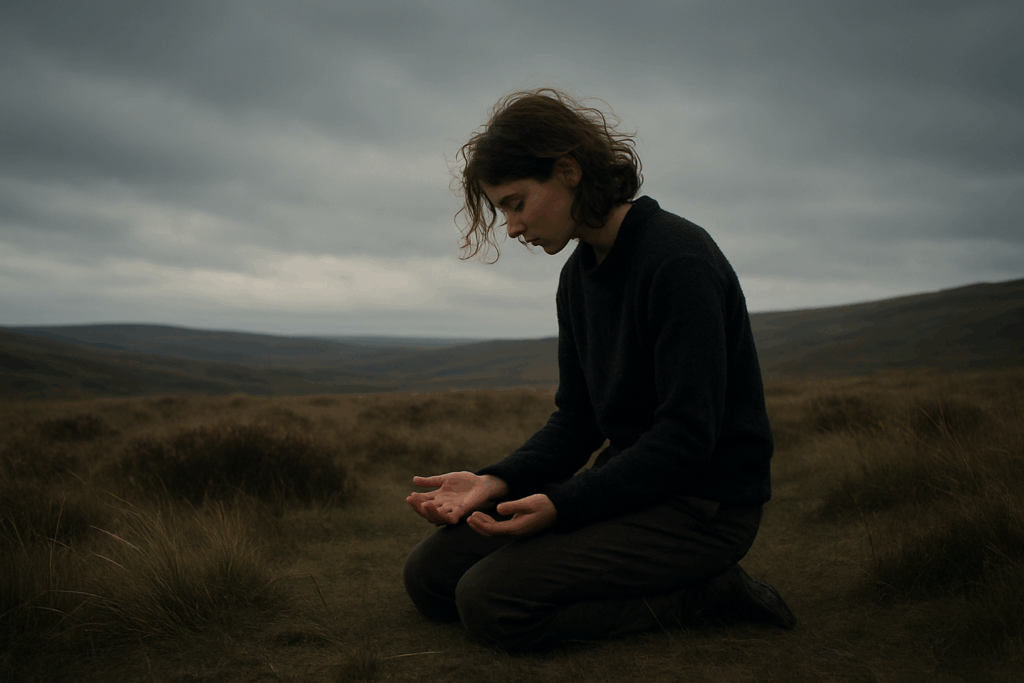
A young person with short, curly hair kneels alone on a windswept moor under a heavy grey sky. They look down at their open hands, held gently in front of them, as if in reflection or quiet sorrow. The surrounding landscape is empty, muted, and expansive, conveying a sense of solitude and introspection.

Sensitivity and Mental Health in an Unfeeling Culture

What happens when you reach out to the world with your full, feeling self – and the world doesn’t feel back?

For sensitive people, this isn’t a hypothetical question. It’s a daily reality. They walk through life with open hearts, attuned nervous systems, and deep responsiveness to beauty, pain, and meaning – and they often find themselves in a culture that values none of those things.

This post explores the toll that takes. But more than that, it offers a reframing: what if the overwhelm, the anxiety, the depression, the disorientation – were not personal defects, but soulful responses to a world that has forgotten how to feel?

Prefer to watch rather than read? Check out the video below.

The Culture That Invalidates Sensitivity

We live in a culture that exalts speed, noise, productivity, and surface-level positivity. There is little room for pause, for nuance, for grief, or for complexity. To be emotionally present in this kind of culture is often exhausting – and sometimes unbearable.

Sensitive people are told:

  • “You’re too much.”
  • “Don’t take it so personally.”
  • “You need thicker skin.”
  • “Everyone’s struggling, just get on with it.”

The underlying message is clear: If you feel deeply, the problem is you.

But what if the problem is the world’s refusal to feel?

When Mental Health Struggles Are Acts of Integrity

What if anxiety isn’t a sign of disorder, but a sign of awareness? What if burnout isn’t a personal failure, but a soul’s rebellion against unsustainable expectations? What if depression is not dysfunction, but a form of grief – for the earth, for lost futures, for disconnection?

In this light, breakdowns become not shameful but meaningful – calls to pay attention, to re-evaluate, to reconfigure.

This is not to romanticise suffering. It’s to honour it. To recognise that the psyche, like the body, protests when its needs are unmet. It doesn’t just shut down out of nowhere – it sends signals. It breaks open.

As Thomas Moore writes, the symptoms of the soul are often expressions of its longing. They are not to be fixed or silenced but listened to.

A Soulful Reframing of Breakdown

To be sensitive in a numb culture is to constantly register what others ignore. And over time, that can lead to exhaustion, despair, and disillusionment. But these states may also mark the threshold of deeper truth.

Sometimes, what looks like a breakdown is actually a breakthrough – an insistence that something in your life (or the world) is out of alignment. That your values are being compromised. That your way of being can’t keep bending to systems that don’t care.

When seen through a soulful lens, the question is not “How do I make this stop?” but “What is this trying to show me?”

What Sensitive People Need to Stay Whole

To live with sensitivity in a world that often numbs requires deep self-care and soulful scaffolding. Not the quick-fix kind, but the kind that honours your wiring.

Sensitive people often need:

  • Slower rhythms and restorative solitude
  • Beauty, creativity, and connection to nature
  • Purposeful work that aligns with their values
  • Safe relationships that validate and reflect
  • Permission to feel without being pathologized

They also need community. Sensitivity thrives in mutual care, in collective rhythm, in spaces that allow for emotional honesty. Isolation makes it harder. Structure supports it.

You are not meant to carry it all alone.

Damon Zahariades’ The Art of Going Slow is a practical guide to stepping back from the cult of speed. In my review, I reflect on how his call to slow living creates space where sensitivity can be honoured rather than invalidated.

Feeling as Truth

In an unfeeling world, the sensitive soul is not dysfunctional – they are attuned. And their struggles are not signs of failure, but signals of truth.

To feel is to remain in relationship – with self, with others, with the earth, with what matters.

So, if you’re struggling right now, know this: you are not broken. You may simply be one of the few still feeling in a world that has gone numb.

And that makes you not weak – but wise.

For reflection

  • Have you ever questioned whether your sensitivity was a sign of something “wrong”?
  • In what ways has your sensitivity shown up as integrity rather than dysfunction?
  • What changes when you see your deep feeling not as illness, but as wisdom?

Coming up next

In the final post of this series, we’ll look at how sensitivity may be part of a larger shift – not something to overcome, but something to grow into. A sign of the next kind of human emerging.

Until then, ask yourself gently: What if the part of you that’s struggling is not the part that needs fixing, but the part that needs honouring?

Return to the start of this series

Rethinking “Survival of the Fittest”

A deer stands quietly in a misty forest, bathed in soft early morning light streaming through the trees. The atmosphere feels calm and ethereal, evoking sensitivity, stillness, and connection with nature.

What comes to mind when you hear the phrase survival of the fittest? For many of us, it conjures images of strength, dominance, speed, or emotional detachment – the biggest, the toughest, the last one standing.

But that’s not what Darwin meant. And it’s certainly not what we need now.

The phrase wasn’t even coined by Darwin but by Herbert Spencer, and it’s often been misused to justify competition, cruelty, and exclusion. In reality, nature is full of examples of mutual aid, responsiveness, and deep attunement to relationship and environment. Survival, in evolutionary terms, has far more to do with adaptability than with aggression.

And that’s where sensitivity comes in.

If you’d rather watch or listen, I’ve recorded a video version of this reflection. It brings together the core message in a more embodied way – feel free to pause and reflect as you go.

Evolution Is Not About Strength Alone

The natural world is rich with examples of life forms that survive through attunement, not brute force:

  • Mycelial networks communicate underground, sensing and responding to changes in soil and moisture.
  • Elephants detect seismic vibrations through their feet, aware of distant rumblings long before danger arrives.
  • Flocking birds move in unison, shifting direction not through hierarchy but through responsive interconnection.

These are not signs of fragility. They are expressions of finely tuned awareness – and they point to a broader truth:

Sensitivity is a form of intelligence.

In human terms, sensitivity allows us to perceive subtle shifts – in mood, in systems, in relationships, in the natural world. It helps us adapt not just physically, but emotionally, ethically, and spiritually. It’s not weakness. It’s wisdom.

Sensitive People as Early Warning Systems

Sensitive people often notice things before others do. They may sense when a conversation turns, even if no words are spoken. They may feel the exhaustion in a workplace long before burnout becomes visible. They may grieve the climate crisis before the headlines catch up.

This isn’t overreaction. It’s early detection.

In ecosystems, we rely on keystone species and indicator species – the ones that reflect the health of the whole. Sensitive people often serve a similar role in human culture. They feel what others suppress. They notice the cracks in the system. They respond when others are still distracting themselves.

Sensitivity is feedback – and in times of collapse, feedback is everything.

Sensitivity in Times of Collapse

We are living through radical uncertainty. Social systems are fraying. Ecological systems are buckling. The pace of change is accelerating, and many of the old maps no longer work.

In such times, we don’t need more bravado. We need more attunement.

Sensitive people bring precisely the qualities needed for this moment:

  • The ability to feel what’s changing
  • The courage to name discomfort and grief
  • The capacity to imagine new ways of relating
  • The impulse to protect, connect, and care

They may not always feel strong – but they are resilient in a deeper, more relational way. They don’t power through; they listen through. They are, in many ways, the Edge Dwellers and Seers of our time – perceiving not only what is breaking down, but what is trying to emerge.

My review of Bill Plotkin’s Nature and the Human Soul explores his soulful model of human development. Plotkin shows how ecological awareness and sensitivity to life’s deeper patterns are essential for genuine growth.

Rewriting Fitness for the Future

What does it mean to be “fit” for the world we’re entering?

Perhaps it means:

  • Staying sensitive to suffering – and responding with compassion
  • Remaining rooted in values even when the ground shifts
  • Choosing co-regulation over domination
  • Being willing to adapt without abandoning who we are
  • Honouring nuance over certainty, connection over control

This is a different kind of fitness – not about domination, but about deep participation. Not about competing, but about co-evolving.

Closing: Evolution as Awakening

What if evolution isn’t just about surviving, but about awakening? What if your sensitivity – your ability to feel, to intuit, to respond – is not a burden, but your evolutionary gift?

In this time of unravelling and reimagining, the world doesn’t need more people who can shut down. It needs more people who can stay awake.

And that includes you.


In the next post, we’ll explore how living in a culture that devalues sensitivity affects mental health – and how breakdowns may sometimes be signs of inner integrity, not dysfunction.

Until then, consider this: When has your sensitivity helped you navigate a change – or sense one coming? What would it mean to trust it more fully?

Snowflake or Seer?

A young person stands in a quiet rural landscape at dusk, gazing thoughtfully toward the horizon. The sky is filled with dramatic clouds tinged by soft evening light, and a few birds fly in the distance. The person wears a textured cardigan and neutral-toned clothes, evoking a calm, introspective mood against the natural backdrop of fields and forest.

A Soulful Defence of the So-Called Sensitive Generation

Somewhere along the way, a generation began to be called “snowflakes.” The term, flung like an insult, suggested they were delicate, thin-skinned, unable to cope with discomfort or disagreement. It implied that feeling deeply was somehow shameful — and caring about justice, identity, mental health, or the planet was a sign of weakness.

But what if this wasn’t fragility at all? What if it was clarity?

What if those being called “snowflakes” were actually perceiving something others couldn’t – or wouldn’t – acknowledge? What if they were not collapsing, but responding appropriately to a collapsing world?

I’ve created a companion video for this post that explores the “snowflake” label and why sensitivity might be our clearest form of truth-telling. You can watch it here:

The Snowflake Slur: A Symptom of Cultural Denial

The word “snowflake” has become shorthand for over-sensitivity, particularly when younger generations express outrage, distress, or vulnerability. But the use of this term often reveals more about the speaker than the target. It deflects discomfort. It mocks moral concern. It avoids having to look more deeply at what’s being felt – and why.

In truth, the emotional intensity of younger generations is not a flaw. It is a signal. One that says: Something is wrong here.

They are not “offended by everything.” They are refusing to stay silent in the face of harm. They are not collapsing – they are refusing to dissociate. In a world conditioned to numbness, distraction, and performance, this alone is radical.

Seeing Clearly in a Failing System

Younger people are growing up in a context where the climate is breaking down, inequality is rampant, and old institutions no longer inspire trust. Of course they feel anxious. Of course they question inherited norms. Of course they’re angry, confused, and unwilling to play by the old rules.

This is not a generational weakness. It’s a generational truth-telling.

We could say they are fragile. Or we could say: they feel the tremors first. They name the injustices. They name the grief. They are mirrors we may not want to look into – but urgently need to.

From Snowflake to Seer: Reframing the Role

Instead of pathologising this sensitivity, what if we saw it as a kind of second sight? An emotional and ethical attunement to the deeper currents of our time?

This is the realm of the Edge Dweller – an Alternative Archetype (not yet published) that thrives at thresholds. The Edge Dweller lives at the borders between the old and the emerging, between breakdown and breakthrough. They are not rebels for rebellion’s sake – they are listeners, feelers, messengers. They perceive what’s shifting long before the centre does.

To dismiss them as snowflakes is to ignore the edge wisdom they carry.

In Consider the Ravens, Paul and Karen Fredette share the wisdom of modern hermits. In my review, I reflect on how their witness offers a quiet but radical counterbalance to a culture of speed and distraction, reminding us of the value of stillness and depth.

The Need for Elders, Not Critics

This moment in history doesn’t call for more scorn. It calls for eldership. Not in the sense of age, but of orientation – those who are willing to meet younger generations with listening, not judgment.

We don’t need to harden them. We need to honour them.

To support them not in toughening up, but in deepening their gifts. To create space for their grief, their vision, their fierce refusal to settle for a world that harms.

Choosing How We Respond

What if we responded to the “snowflake” insult not with defensiveness, but with curiosity?

What if, instead of asking Why are they so sensitive? we asked What are they sensing that we’re not?

And what if that sensitivity – far from being a flaw – turned out to be a compass pointing us toward what matters most?

For reflection

  • Have you ever been labelled “too sensitive,” and how did it shape your view of yourself?
  • Do you see sensitivity in younger generations as a strength or a challenge? Why?
  • How might we, as individuals or communities, offer eldership instead of criticism to those who feel deeply?

Coming up

In the next post, we’ll look more deeply at how sensitivity is not just a personality trait, but an evolutionary asset – one that may be essential for surviving and reimagining life in a time of collapse.

Until then, consider this: Have you ever dismissed someone’s sensitivity – or your own? What becomes possible when we choose to see it differently?

Return to the start of this series on Sensitivity here

Why the World Needs Sensitive People Right Now

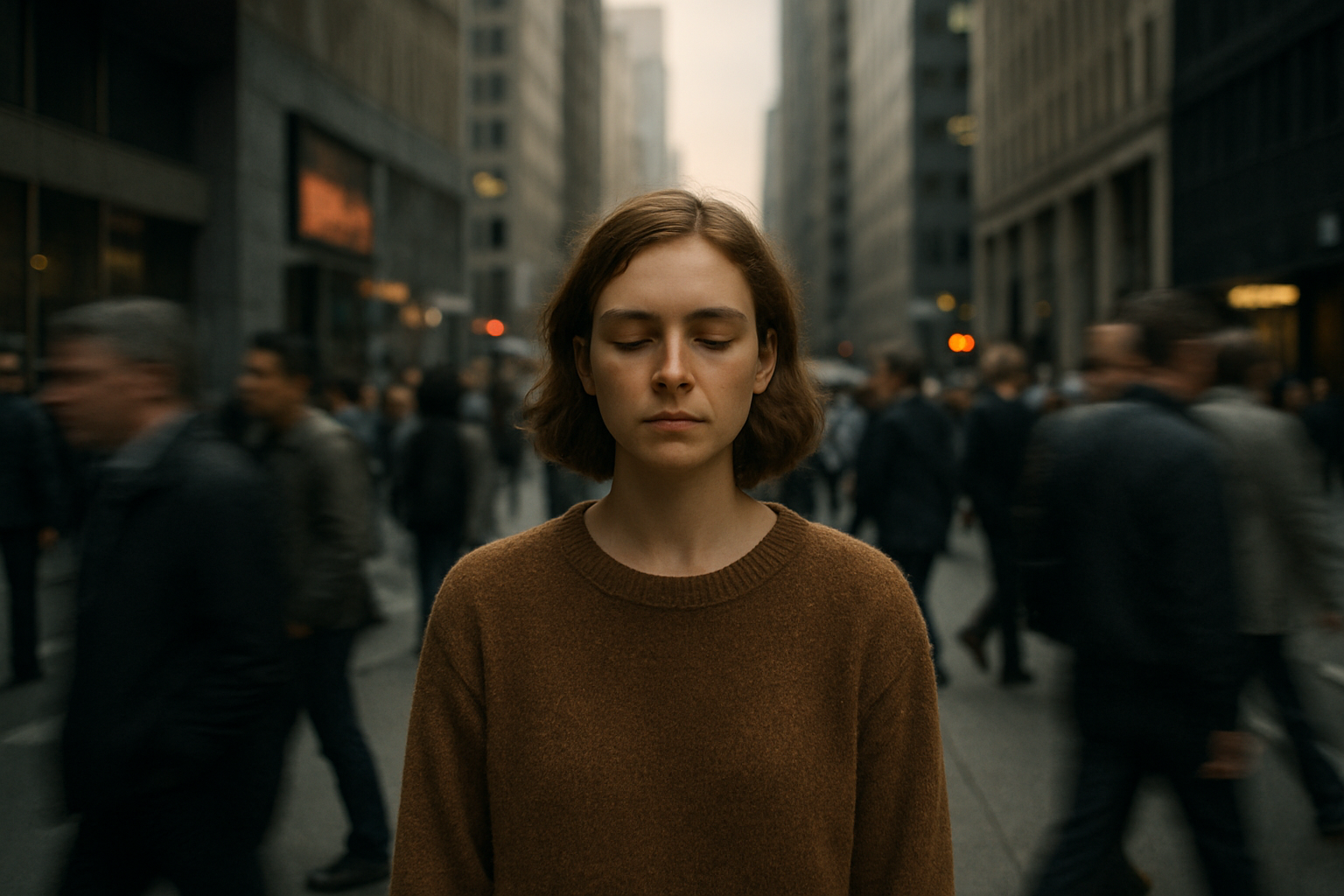
A young woman with short brown hair stands still in the middle of a busy city street, eyes closed and calm, while people rush past her in motion blur. The scene conveys a sense of sensitivity, introspection, and inner peace amid chaos.

In the last post, we explored what sensitivity really is – not a weakness, but a form of perceptive strength, a quiet attunement to emotion, relationship, place, and atmosphere. Now we take a step further. If sensitivity is such a rich and vital gift, why has it been so widely misunderstood, dismissed, or even pathologised? And what might shift if we recognised it as essential rather than excessive?

In a world increasingly defined by speed, noise, and disconnection, the sensitive person can feel like an outlier – a glitch in a system that has no time for depth. But the truth is, sensitive people may be carrying the very medicine this world needs.

If you’d prefer to take this in via video, I’ve shared a spoken version of this reflection below

A Culture That Pushes Sensitivity Aside

Mainstream culture is built on values that often run counter to sensitivity:

  • Toughness and stoicism are praised, especially in men, but increasingly demanded of all genders.
  • Efficiency and output are elevated above presence and reflection.
  • Emotional detachment is rewarded — in politics, workplaces, even in relationships.
  • Capitalist logic prioritises measurement, not meaning. It flattens nuance and discourages internal awareness.
  • Digital culture bombards us with stimulus but rarely invites stillness.

In this context, sensitivity is inconvenient. It slows things down. It asks questions that can’t be answered with metrics. It calls attention to what feels off – in systems, in speech, in silence.

And so it is minimised. Medicalised. Mocked. Or shamed.

The Numbing of a Culture

But if sensitivity has been rejected, what has replaced it?

A kind of collective numbness. A culture of distraction, sarcasm, and overstimulation. The constant scrolling. The tendency to mock or dismiss rather than feel or engage. The ways we speed up when we most need to slow down.

This is not a personal failing – it’s a systemic condition. In a traumatised culture, numbness can feel like safety. But it is also a form of disconnection. And that disconnection is what allows harm to continue unchecked: to ourselves, to each other, and to the planet.

In this landscape, the sensitive person becomes an anomaly – someone who still feels, still cares, still notices. Not because they are fragile, but because they are awake.

Sensitivity as Wakefulness

What if we stopped seeing sensitivity as a flaw, and started recognising it as a form of wakefulness?

Sensitive people:

  • Detect subtle changes in mood, energy, or atmosphere.
  • Feel moral and emotional dissonance with great clarity.
  • Respond with empathy rather than defensiveness.
  • Struggle to look away from suffering – and are often moved to action because of it.
  • Offer a kind of emotional truth-telling that our world sorely needs.

These are not signs of dysfunction. These are signals of health in an unwell system.

There is a quiet resilience in the sensitive person – not the resilience of “bouncing back” at all costs, but the resilience of remaining in relationship with what matters. With beauty. With pain. With people. With place.

My review of Marsha Sinetar’s Ordinary People as Monks and Mystics explores how everyday men and women have chosen lives of simplicity and contemplation. Their stories affirm that solitude and sensitivity can be fertile ground for clarity and depth.

It’s Not You – It’s the System

If you have ever felt like you were “too much” or “not enough,” it’s worth asking: by whose standards? If you’ve been overwhelmed by the world, maybe it’s not because you’re broken – maybe it’s because the world is too loud, too fast, too cruel.

You are not weak for being affected. You are not broken for needing rest. You are not wrong for feeling deeply.

You may, in fact, be responding appropriately to a culture that has lost its way.

An Invitation to Reclaim Sensitivity

What if your sensitivity wasn’t something to fix – but something to follow? What if it were not a deficit to overcome, but a compass to trust?

The world is changing. Collapse is no longer a distant possibility – it’s a living context. In this time of unravelling, we don’t need more detachment or distraction. We need more people who are willing to feel. Who are willing to stay awake. Who are willing to respond.

And that means we need you.

For reflection

  • Have you ever felt like your sensitivity made you “too much”? What was that experience like?
  • What would it feel like to stop trying to fix your sensitivity-and start honouring it?
  • Can you think of a moment when your sensitivity revealed something important that others missed?

In the next post, we’ll take a closer look at how younger generations – often labelled as fragile or oversensitive – are in fact responding wisely to a deeply unstable world. The insult of “snowflake” may mask a powerful truth: that to feel in a broken system is not weakness, but clarity.

What Is Sensitivity, Really? Reclaiming a Misunderstood Human Gift

A person with shoulder-length hair wearing a brown sweater stands at the edge of a calm river, gazing across the misty water. Morning light filters through trees on both sides of the river, and two birds fly overhead, creating a peaceful, contemplative atmosphere

In my last series, we explored the hidden architecture of the dominant paradigm – the values and assumptions that shape modern life, often without our awareness. That series challenged the cultural obsession with toughness, productivity, and control, and asked what might lie beyond those well-worn narratives. This new series picks up the thread with something the dominant paradigm has long sought to suppress: sensitivity.

From an early age, many of us were told we were “too sensitive.” Perhaps it was said with affection, perhaps with exasperation –  but the message was clear: feeling deeply was a problem to outgrow. In a culture that favours sharp edges and thick skins, sensitivity can seem like a flaw, a liability, or at best, an inconvenience.

But what if the opposite were true? What if sensitivity was never the problem – but the very quality most needed in our time?

If you’d prefer to listen or watch, I’ve shared a short video version of this reflection here. Feel free to pause and take it in at your own pace

The Many Dimensions of Sensitivity

Sensitivity is often reduced to just one thing – emotional fragility, perhaps, or being easily upset. But in truth, it is a rich, multidimensional capacity:

  • Emotional sensitivity – attunement to the subtle shifts in one’s own and others’ emotions.
  • Sensory sensitivity – heightened awareness of sounds, smells, textures, or light.
  • Moral sensitivity – a deep response to injustice, suffering, or ethical misalignment.
  • Environmental sensitivity – noticing shifts in atmosphere, tone, or place.
  • Relational sensitivity – being finely tuned to dynamics in a group or between people.
  • Intuitive sensitivity – perceiving connections, patterns, or insights that lie beneath the surface.

These forms of sensitivity are not weaknesses. They are modes of perception – ways of taking in, making sense of, and responding to the world. Sensitivity is a kind of perceptual fluency in the unseen and the subtle.

What Sensitivity Is Not

It’s important to be clear about what sensitivity is not.

  • It is not weakness.
  • It is not a failure to cope.
  • It is not immaturity.
  • It is not about being easily offended or lacking resilience.

These misunderstandings stem from a cultural discomfort with vulnerability, nuance, and anything that cannot be measured or controlled. In a world that often rewards detachment and numbness, the capacity to feel is wrongly framed as a flaw. But feeling is not failure – it is feedback. And feedback is essential if we are to stay responsive to what matters.

Why Sensitivity Has Been Marginalised

To understand why sensitivity has been misunderstood or even pathologized, we need to return to the dominant paradigm. For centuries, Western culture has exalted strength, certainty, and rational control – often at the expense of connection, care, and receptivity. The sensitive person doesn’t fit easily into a system that values speed over depth and productivity over presence.

Industrialism, capitalism, and patriarchy have all played their part in this marginalisation. So has the rise of digital culture, which prizes the rapid-fire exchange of information over embodied knowing. In this context, the sensitive person can seem like an anomaly – too slow, too porous, too much.

But maybe the sensitive person isn’t behind the times. Maybe they’re ahead of them.

Sensitivity as a Quiet Superpower

What if sensitivity is not something to overcome, but something to reclaim? What if it is a soulful strength – a gift of attunement to what is real, alive, and in need of care?

A sensitive person might notice the moment a room goes tense. They might feel the unspoken grief behind someone’s smile. They might weep at the beauty of birdsong or the injustice of a news headline. These responses are not excessive. They are reminders that our hearts are still awake.

Sensitivity allows us to stay in relationship – with ourselves, with each other, and with the living world. It asks us to feel our way rather than force our way. And in a time of ecological crisis, social fragmentation, and digital dissociation, that might be the most radical act of all.

For a deeper dive into the research that first gave sensitivity its name and recognition, see my review of Elaine Aron’s The Highly Sensitive Person – the book that first gave language and validation to millions of sensitive people worldwide.

An Invitation

So here is an invitation, not just for this post but for the series to come: to stop apologising for your sensitivity and start exploring what it has to teach you. What if it’s not the thing holding you back, but the thing holding you together?

In the next post, we’ll explore why sensitivity has been so often misunderstood – and why the world urgently needs more people who are willing to feel.

For reflection

  • When have you felt your sensitivity was misunderstood – or dismissed?
  • Which dimension of sensitivity feels most familiar to you: emotional, sensory, moral, environmental, relational, or intuitive?
  • What might change if you treated your sensitivity as a strength rather than a liability?