Finding Flow

Mihaly Csikszentmihalyi’s Flow: The Psychology of Optimal Experience explores where true fulfillment lies- not in external achievements or fleeting pleasures, but in moments of deep engagement. Flow is that state when challenge and skill are perfectly balanced: time falls away, distractions vanish, and the act itself becomes its own reward.

Csikszentmihalyi’s insights remain urgent today. In a culture of distraction, consumption, and relentless metrics, flow offers a different path: a life rooted in intrinsic motivation and meaningful activity. Whether gardening, teaching, painting, or simply tackling a puzzle, flow moments remind us that wholeness is found not in outcomes but in presence.

For me, this idea connected with the way my dad lived. Though he left school at 14, he pursued projects that fascinated him—writing, researching, creating – without much concern for recognition. His joy was in the process, not the product. He embodied what Csikszentmihalyi calls the autotelic personality: one who creates meaning from within.

In alternative archetypal terms, The Disciple and The Artist capture this spirit of flow – devoted, inwardly motivated, and finding joy in practice itself.

Flow remains a powerful reminder that we can design lives around what nourishes us intrinsically. In doing so, we reclaim not just our attention, but our humanity.
The Self-Directed Life

How to Live Deeply in a Fragmented World

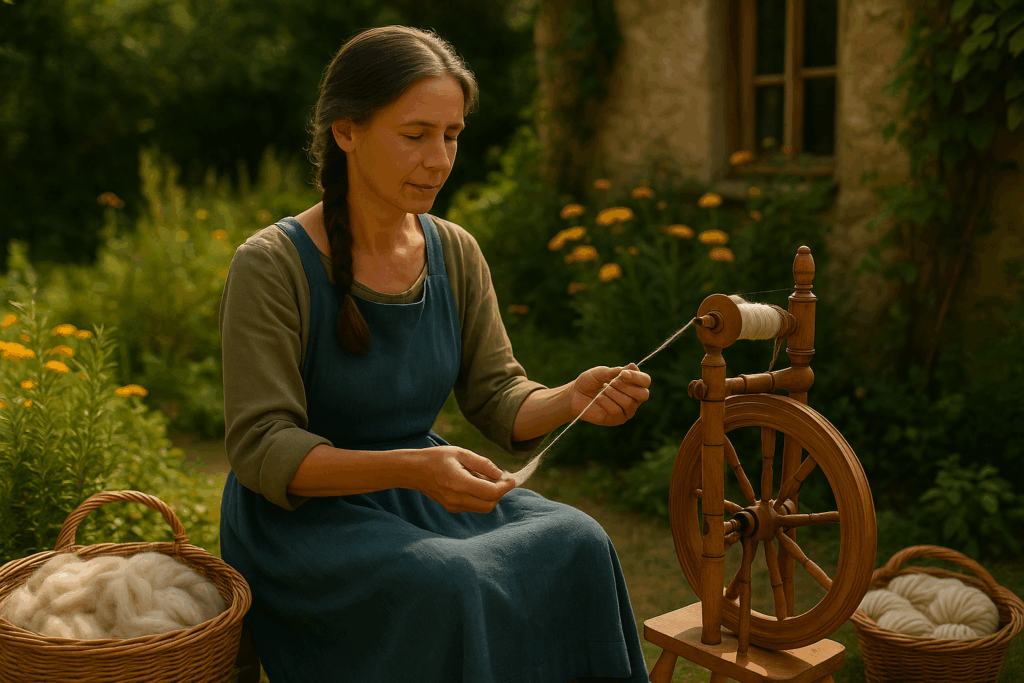
A woman with a long braid sits outdoors on a sunny day, calmly spinning wool on a wooden spinning wheel. She wears a simple blue pinafore over a long-sleeved top, with baskets of unspun wool beside her. Yellow flowers and greenery surround her, creating a peaceful, rustic atmosphere.

We live in a world that prizes speed, productivity, and constant visibility. Yet beneath the noise, many of us feel a quiet hunger – a longing for meaning that can’t be measured or optimised. We sense that something vital has been lost: depth, coherence, and the freedom to live from our own inner compass.

This series, The Self-Directed Life, is an exploration of how we might recover that freedom. It asks: What does it mean to live from within, to let the deeper Self guide us, even when the surrounding culture pulls us elsewhere?

Psychologist Mihaly Csikszentmihalyi called this the autotelic life – living for the intrinsic value of experience rather than for external approval. Here I reframe it as the Self-Directed Life: a way of being that is anchored, creative, and quietly resistant.
To live this way is to resist fragmentation and to participate in the slow work of wholeness.

If you prefer to watch rather than read, check out the video below


Why This Series Matters

Living a Self-Directed Life is not about retreating from the world. It’s about engaging with it differently – with clarity, depth, and integrity.
It’s about creating meaning rather than consuming it, and finding satisfaction in the process rather than the product.
In an age of distraction and conformity, such living becomes an act of soulful resistance – one that nourishes not only our own lives but the wider culture we help to shape.

Each post in the series explores a different facet of what it means to live this way.


The Journey Through the Series

  1. The Self-Directed Life
    Introduces the idea of living from the deeper Self – the autotelic life that draws meaning from within rather than from cultural scripts. It’s about reclaiming inner direction and redefining success as wholeness, not performance.
  2. Flow as Resistance
    Explores how giving ourselves wholly to meaningful work or creativity can become a quiet act of rebellion in an age of distraction. Choosing depth over noise restores focus and inner vitality.
  3. Inner Authority in a Culture of Noise
    Looks at how we discern which voice to trust amid constant external pressure. Drawing on Thomas Berry and the reclaimed Spinster archetype, it examines self-trust as the anchor of a Self-Directed Life.
  4. Crafting a Soulful Life
    Reflects on how we bring soul into form – shaping our days as acts of artistry and care. Through small, steady practices, life becomes something crafted rather than consumed.
  5. The Self-Directed Personality as an Evolutionary Response
    Expands the lens to show how self-directed living supports cultural evolution. The Wayshower archetype embodies this stance – quietly modelling new ways of being that ripple outward.
  6. Becoming Whole in a Broken World
    Weaves the threads together, exploring how living from the deeper Self is both a personal and collective act of renewal. It points toward wholeness as a practice – one that reconnects us with each other and with the living world.

Soulful Path Support

The Soulful Path to Life Purpose programme was created to help people live precisely this way.
Through values, strengths, archetypes, soulful projects and more, it offers practical tools for cultivating inner authority, meaning, and wholeness – companions for anyone ready to live a Self-Directed Life.


Closing Invitation

To live self-directedly is to choose presence over performance, purpose over approval, soul over speed.
It’s a path that begins quietly — in attention, in care, in the courage to listen inwardly — yet it ripples outward in transformative ways.

So, I leave you with this question:

What might a Self-Directed Life look like for you, here and now?

Introducing the Festivals of Light series

Hope, Renewal & Inner Brightness

As the nights draw in and the world feels a little heavier, humanity has always reached for light. Candles, lanterns, hearth fires, lamps glowing in windows – across cultures, light has acted as a quiet declaration: hope lives here.

This time of year often invites us into a more reflective mood. The natural slowing of the season can create space to pause, take stock, and reconnect with meaning. The Festivals of Light series was created to honour that quieter impulse – a curated space for reflection, renewal, and soul-tending as we move toward the turning of the year.

This series gathers several essays into one place, weaving together cultural symbolism, spiritual insight, and practices for tending your inner brightness. Whether you’re navigating an “inner winter,” seeking a gentler rhythm, or simply wanting to end the year with intention, the reflections offer a handrail of light as you walk.


Why focus on light now?

Across traditions – Diwali, Hanukkah, Yule, Christmas, St. Lucia’s Day – light has long symbolised hope, resilience, and the return of life. These rituals remind us that while darkness is real, it is never the final word.

In a time marked by uncertainty and collective fatigue, reconnecting with symbolic and spiritual forms of light can feel deeply grounding. The series invites you to slow down, soften inwardly, and rediscover a steadier inner flame that doesn’t depend on external conditions.


What you’ll find in the series

The Festivals of Light collection explores:

  • The symbolic power of light across cultures and traditions
  • The cycle of descent and renewal, and how to work with it rather than resist it
  • The relevance of ancient festivals today, especially in a hurried modern world
  • Practical, reflective, and soulful ways of engaging with the season
  • Simple rituals and gentle practices for closing the year and tending inner alignment

Each piece offers an accessible entry point into meaning-led living and spiritual reflection during the darker months.


Who the series is for

This series speaks especially to:

  • sensitives, seekers, and reflective souls
  • anyone experiencing an “inner winter”
  • those craving grounded meaning during the holiday season
  • people on a soulful, purpose-led path
  • carers and change-makers who quietly hold the light for others

If you’re drawn to depth, gentleness, and inner coherence, you’ll feel at home here.


Begin the journey

You can explore the full series here, moving through it in whichever order feels right for you:
👉The Festivals of Light series

I hope that these reflections offer moments of peace, clarity, and quiet illumination just when you need them most.

Is Domination Inevitable?

Reimagining Power, Culture, and the Human Future

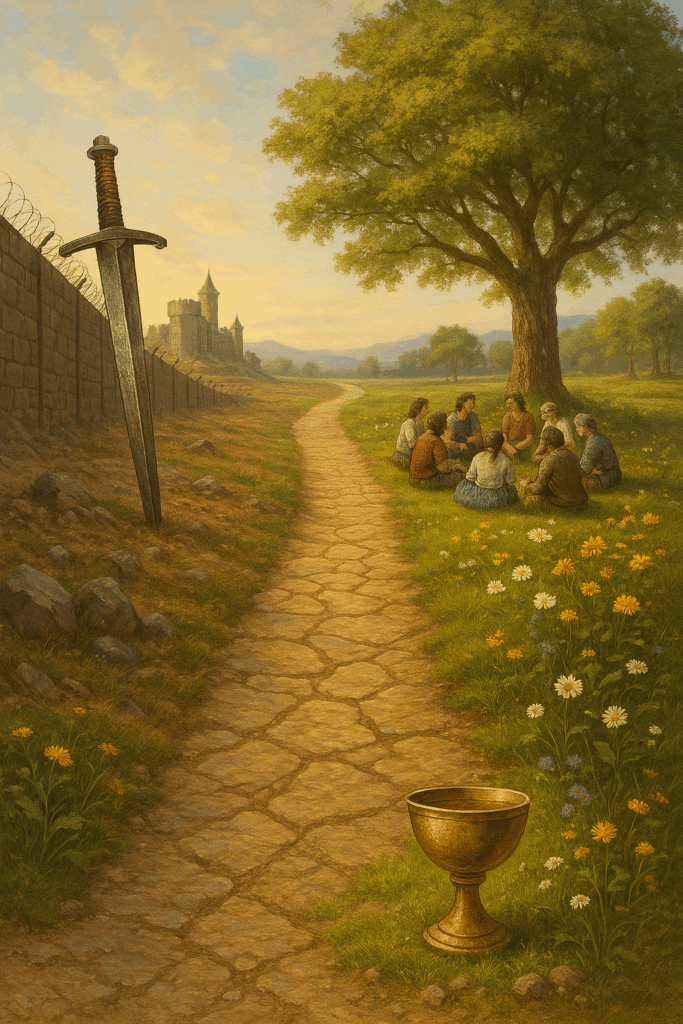
Symbolic crossroads showing two worldviews: on the left, a dark walled fortress with a giant sword symbolising domination; on the right, a vibrant meadow where people gather in a circle under a tree, with a golden chalice in the foreground representing partnership, community, and reverence for life.

Riane Eisler’s The Chalice and the Blade challenges one of the deepest assumptions of our culture: that domination and hierarchy are inevitable. First published in 1987, the book argues that human societies have not always lived by the blade. There is another model available to us – symbolised by the chalice – where cooperation, equality, and reverence for life form the foundation of community.

Eisler drew on archaeological evidence from Neolithic Europe to suggest that early cultures may have embodied this partnership model. While her interpretations have been debated, the bigger point remains: partnership is not fantasy. Indigenous societies around the world show us that chalice values – reciprocity, kinship, consensus – are part of our human inheritance.

Almost four decades later, Eisler’s vision is still urgent. Climate crisis, inequality, and division show the costs of the dominator worldview. Yet we face a choice: do we continue with the blade, or do we cultivate the chalice?

My review explores Eisler’s two models and why the chalice still calls to us today.

Read the full review

If this resonates, you might also enjoy my series Beyond the Dominant Paradigm which digs deeper into the cultural patterns Eisler challenges.